Maharaja's Joker review: Andar Bahar at the palace pool
Andar Bahar is one of the quickest card games there is: one Joker, two lanes, one matching card. Here is how Maharaja's Joker plays and how to use its side bets well.
Published 12 October 2026 · Updated 13 October 2026 · Nocturn Play
Maharaja's Joker is an Andar Bahar card game by Nocturn Play, set beside a moonlit palace pool and hosted by a parrot in a jester's turban. A single card, the Joker, is placed face up; cards are then dealt to two lanes, Andar and Bahar, until one receives a card of the same rank. Alongside the two main bets you can wager on how many cards the round will take and on the Joker itself. Rounds run on a betting timer, and the whole table is free to try on nocturnplay.com.
Where the game comes from
Andar Bahar, literally "inside, outside", is a traditional Indian card game that needs nothing more than a deck and two people willing to guess. Its appeal is the speed and the tension of the deal: a round can end on the first card or drag on for thirty, and nobody knows which until the matching rank appears. Maharaja's Joker keeps those rules unchanged and builds a full betting table around them, in the style of the automated Andar Bahar tables found in online casinos.
The scene and the host
The art leans into the palace fantasy. White marble halls with blue domes line a long pool, oil lamps float on the water among rose petals, and a large moon hangs over the city in the distance. The green parrot who watches over the table wears a gold-trimmed waistcoat and a turban hung with little bells. He leans forward as the deal stretches, sulks briefly when a near thing goes the wrong way and celebrates every win. When you win, a peacock's tail unfolds behind the gold plaque and shakes its feathers while the amount counts up.
Rules, step by step
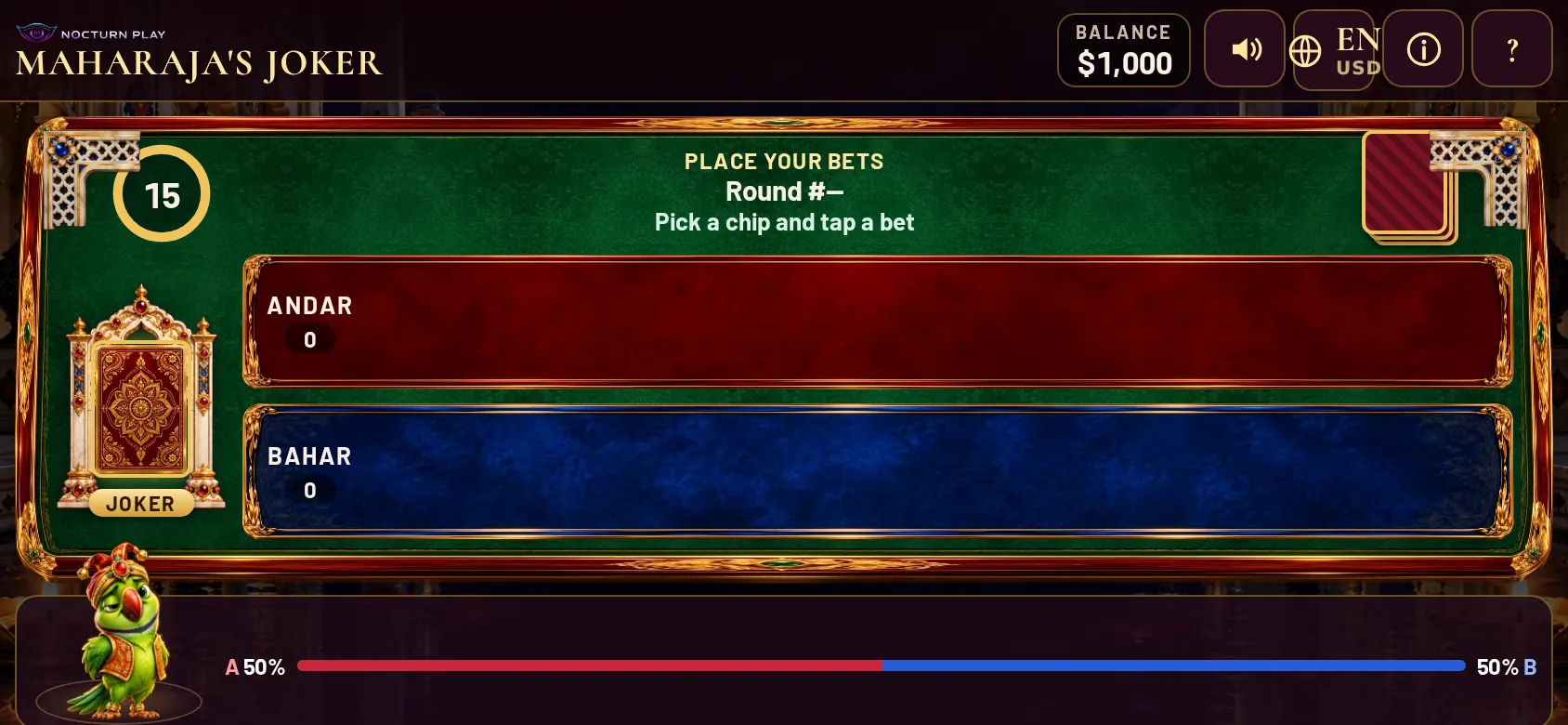
1. Bet. The round opens with a countdown, 15 seconds by default. Choose a chip value from the rack and tap the spots you want to back. You can stack several chips on one spot and spread bets across many.
2. The Joker. When betting closes, one card is drawn from a freshly shuffled deck and placed in the middle. The Joker bets are settled right here.
3. The deal. Cards go one by one to Andar, then Bahar, then Andar again. Each lane shows its growing stack and the counter tracks how many cards have been dealt.
4. The match. As soon as a card of the Joker's rank appears, the deal stops. Its lane wins, and the total number of cards dealt, the matching card included, settles the range bets.
The betting spots explained
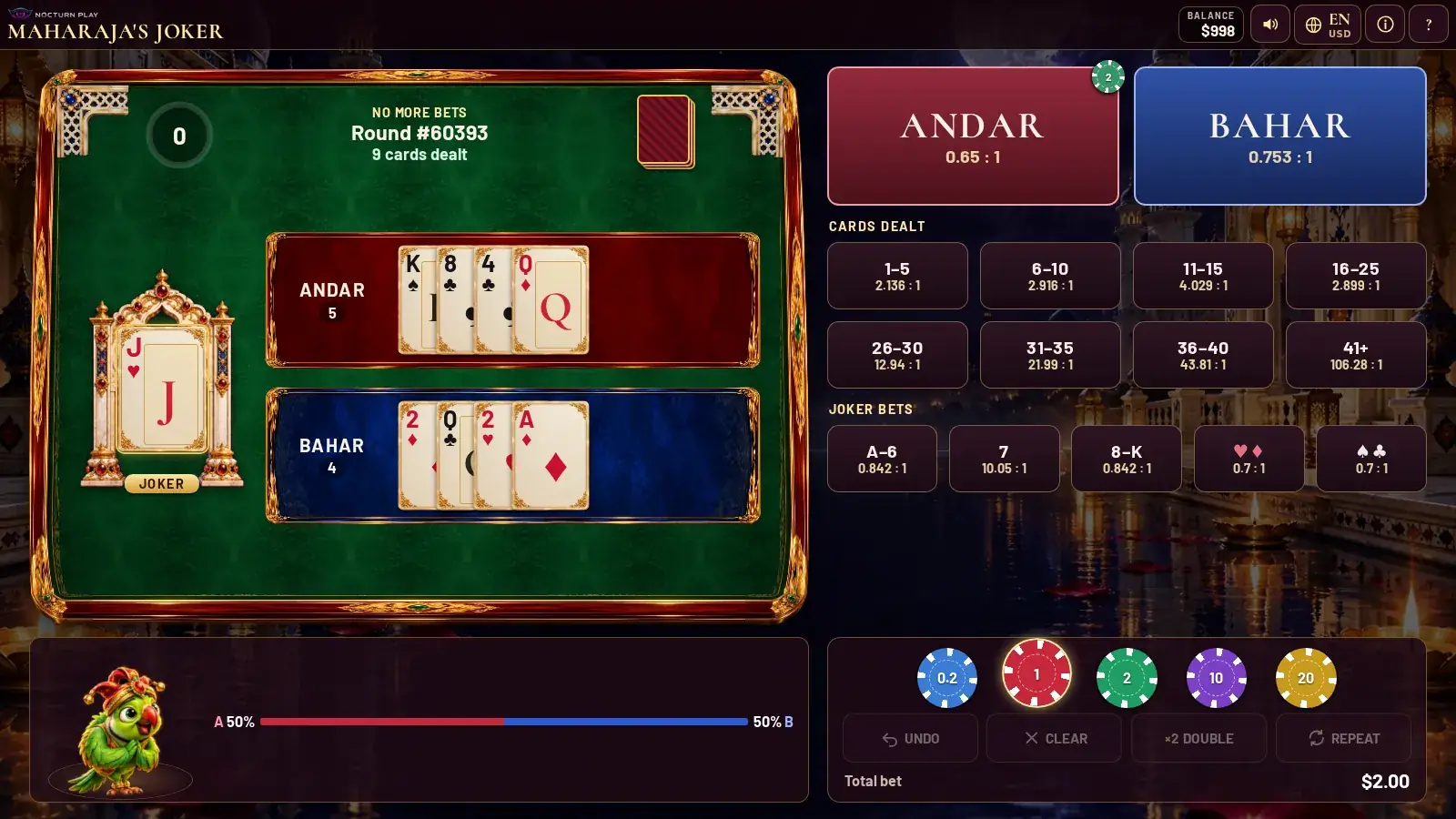
Andar and Bahar are the main event. Because Andar takes the first card, it has a small edge in how often it wins, and the paytable reflects that: Andar pays slightly less than Bahar. Either way, these are close to even-money propositions and the steadiest bets on the table.
Cards dealt splits the length of the round into eight ranges: 1–5, 6–10, 11–15, 16–25, 26–30, 31–35, 36–40 and 41 or more. Short rounds are the most common outcome, since three cards of the Joker's rank are still in the deck and one of them tends to turn up quickly. The ranges are not all the same width: 16–25 covers ten counts, so it lands more often and pays less than the narrower 11–15. From 26 cards on, each range is rarer than the one before and pays more; 41+ is the longest shot and the biggest payout on the board.
Joker bets look at the first card only: low (A to 6), the 7 on its own, high (8 to K), red or black. Low and high each cover six ranks, the 7 just one, so the 7 pays several times more than its neighbours.
Building a layout that suits you
There is no layout that beats the table, but there are layouts that fit different moods.
Calm sessions. A single chip on Andar or Bahar each round. Results swing gently and rounds go by quickly. Repeat saves you from re-placing chips every time.
A main bet with a story. Back a lane and add a small chip on one of the first ranges, 1–5 or 6–10. The deal then has two things to root for: the side and the length.
Long-shot evenings. Keep the main bet small and put a chip on 36–40 or 41+. Most rounds won't get there, but when a deal keeps going and going, every new card raises the tension.
Joker only. Some players skip the lanes entirely and bet on the 7 or on red or black. Those rounds are decided the instant the Joker turns over, which makes for a very fast rhythm.
Whatever you choose, keep an eye on the total bet shown under the table. Each spot has its own maximum, and the table also caps the total for a round.
The bead road
The history beads show the latest results in red for Andar and blue for Bahar, with the number of cards dealt written on each. They are fun to follow and make streaks visible at a glance, but every round is dealt from a newly shuffled deck, so a run of Bahar says nothing about the next round.
Who will like it
Maharaja's Joker is for players who enjoy a live-style table rhythm without waiting for a dealer: a timer, a deal you can watch card by card, and a result in well under a minute. It plays best on a phone held upright, where the lanes, chips and side bets all fit on one screen. If you want another Indian card classic from the same studio, Teen Patti 20-20 is on the Royal Trail page.
To try a few rounds, head to the Maharaja's Joker game page, or browse the full games catalogue for the rest of the Nocturn Play line-up.
Frequently asked questions
Which side wins more often in Andar Bahar?
Andar, by a small margin, because it receives the first card. That is why its payout is a little lower than Bahar's.
Does the matching card count in the cards-dealt bet?
Yes. The count includes every card dealt to Andar and Bahar, the matching card too.
Can I bet on several spots in the same round?
Yes. You can combine lanes, ranges and Joker bets freely, within each spot's maximum and the table's limit per round.
Is the deck reshuffled every round?
Yes. Each round uses a full 52-card deck shuffled before the Joker is drawn.
Can I play Maharaja's Joker for free?
Yes, on nocturnplay.com, on a phone or a computer.