Royal Trail review: Teen Patti 20-20 explained
Teen Patti is often called Indian poker, but you don't need to bluff anyone here. In Royal Trail you pick a hand, watch six cards fall and let the rankings decide.
Published 12 October 2026 · Updated 13 October 2026 · Nocturn Play
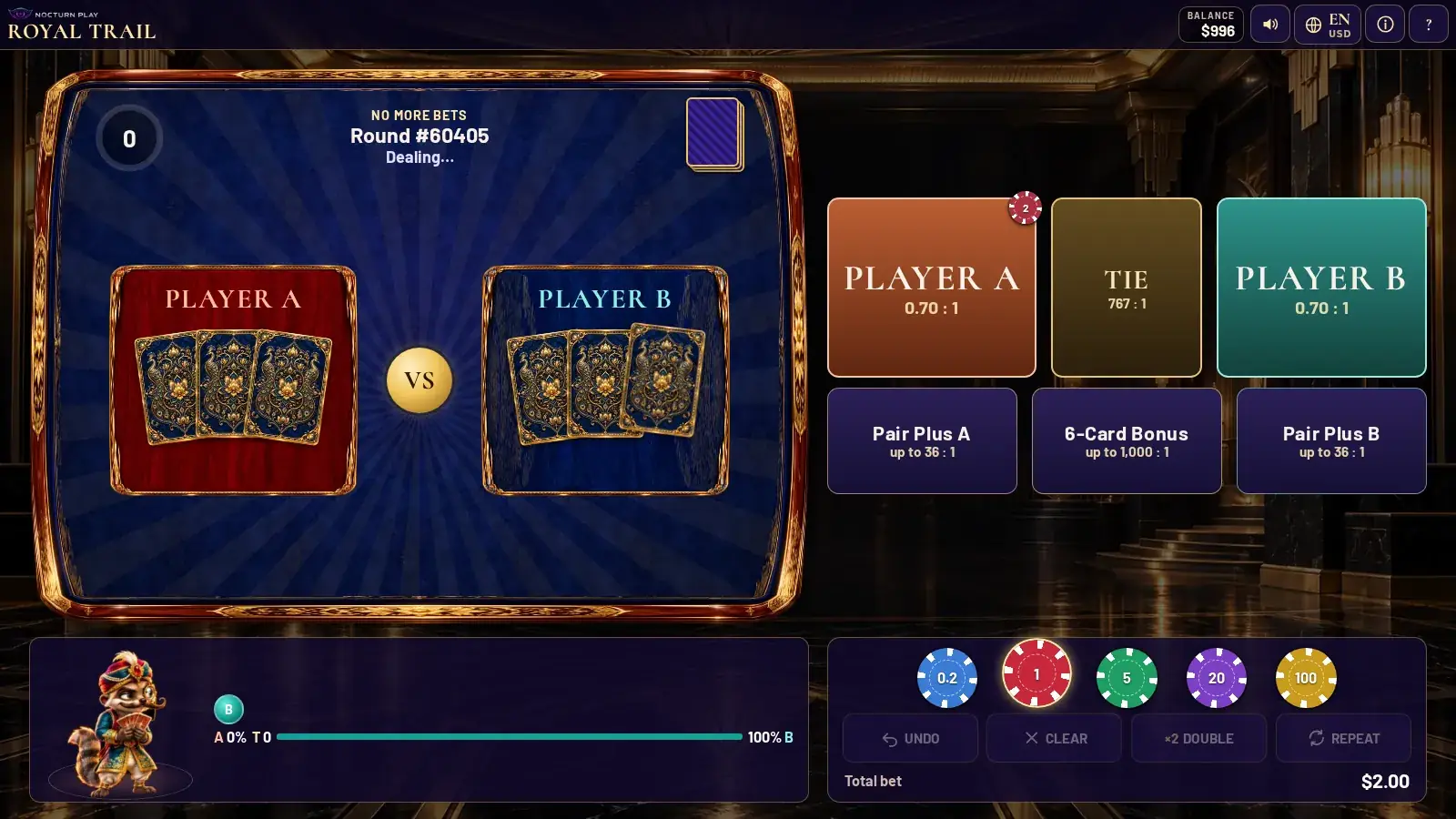
Royal Trail is a Teen Patti 20-20 card game by Nocturn Play in which you bet on which of two three-card hands, Player A or Player B, will be stronger. Around that main bet sit a Tie spot, Pair Plus bets on each hand's own cards and a 6-Card Bonus that pays up to 1,000 to 1 for a royal flush. Rounds last well under a minute, and you can sit down at the table for free on nocturnplay.com.
Teen Patti without the bluffing
In a home game of Teen Patti, players bet against each other, raise, fold and try to read faces. The 20-20 format strips that away. Two hands are dealt in the open, nobody decides anything after the cards come out, and your only job is to choose which hand to back before the deal. What remains is the part everyone enjoys most: the reveal, and the moment you find out whether your side holds a pair or a pure sequence.
An art deco hall and a mongoose in a turban
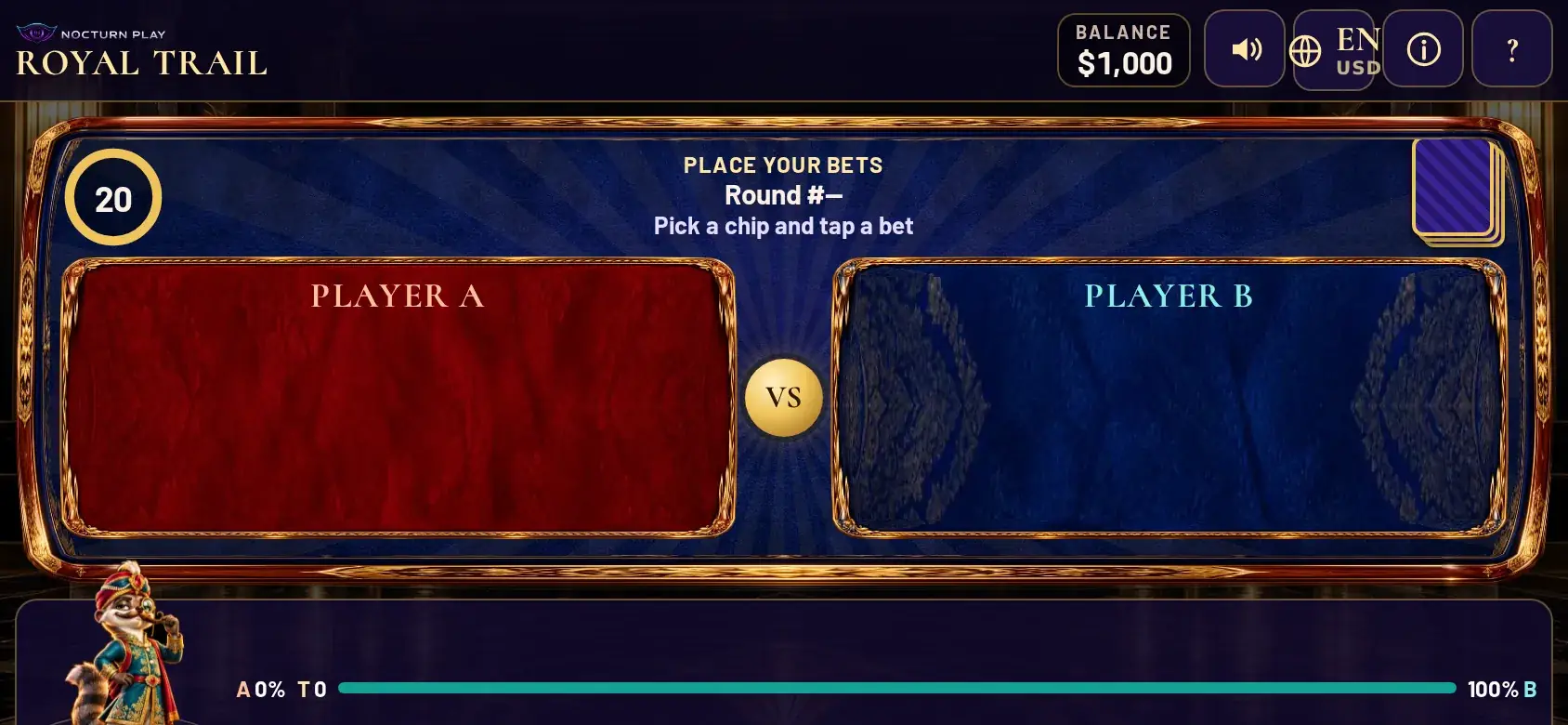
Royal Trail puts the table in a hall of black marble and gold, with stepped columns, fan-shaped mouldings and long glass lamps reflected in the floor. The host is a mongoose in full finery: a red and gold turban with a ruby, a teal sherwani with gold embroidery and a monocle he likes to adjust while you think. Every win brings a lotus flower opening on a gold disc over a turning mandala; bigger ones add a burst of playing cards from all sides.
The hand rankings, from best to worst
Trail. Three cards of the same rank, such as three Kings. The rarest hand and the one the game is named after.
Pure sequence. Three consecutive cards of the same suit, like 9-10-J of hearts.
Sequence. Three consecutive cards in mixed suits.
Colour. Three cards of the same suit that are not in sequence.
Pair. Two cards of the same rank plus a third card.
High card. Anything else, compared from the highest card down.
Two details catch newcomers out. First, A-K-Q is the top sequence and A-2-3 comes right behind it, above K-Q-J. Second, suits never rank, so two hands with identical values are a genuine tie.
One round from start to finish
Say your chip unit is 1. During the 20-second countdown you put 5 on Player B, 1 on Pair Plus B and 1 on the 6-Card Bonus. Betting closes and the shoe deals six cards alternately. Player A turns over 8-8-3: a Pair. Player B shows 5-6-7, all spades: a Pure sequence. Player B wins and your 5 is paid; Pair Plus B pays on the Pure sequence, one of the higher rungs of its ladder. The 6-Card Bonus then reads all six cards together: 3, 5, 6, 7, 8 and 8. One 4 would have made a straight; without it, the best poker hand is a pair of eights, which does not qualify, and that chip is lost. Net result: a healthy win, and a near miss on the bonus to talk about.
Using the side bets well
Player A or B on its own is the calm way to play. The two sides pay the same and win equally often, so the choice is purely personal.
Pair Plus is for players who want something to happen on every deal. It does not care who wins, only what one hand holds, starting with a Pair at 1 to 1. Backing Pair Plus on the hand you also back for the win gives you two reasons to cheer when it turns over a strong combination.
The 6-Card Bonus is the long shot. It needs at least three of a kind among the six cards, and the top prizes, four of a kind at 100 to 1, a straight flush at 200 to 1 and a royal flush at 1,000 to 1, are rare events. A small chip each round is the usual way to play it.
The Tie pays a large amount because exactly equal hands are very rare. It is a lottery ticket rather than a plan, and on a tie your Player A or B bets are returned anyway.
Repeat restores last round's chips in one tap and Double doubles everything on the table. Each spot has its own maximum, so very large layouts may hit a limit.
The bead road and what it is for
Results are logged as beads: orange for Player A, teal for Player B, gold for a Tie. They make a session's flow visible at a glance. Each round is dealt from a newly shuffled deck, though, so the beads describe the past without predicting anything.
Who should try Royal Trail
If you already know Teen Patti, Royal Trail gives you the format you know with quick rounds and good-looking reveals. If you are new to it, it is an easy way to learn the rankings, since every hand is named on screen the moment it turns over. Players who like Andar Bahar can find it at the next table over, in Maharaja's Joker.
Take a seat on the Royal Trail game page to play for free, or explore the other titles in the Nocturn Play catalogue.
Frequently asked questions
What is a Trail in Teen Patti?
Three cards of the same rank. It is the strongest hand in Teen Patti, ahead of a pure sequence.
Is A-2-3 a high or low sequence?
High. In Royal Trail, A-K-Q is the best sequence and A-2-3 is the second best.
Do Player A and Player B pay the same?
Yes. Both sides have the same chance and the same payout.
Does Pair Plus depend on which hand wins?
No. Pair Plus A and Pair Plus B only look at the three cards of their own hand.
How much can one round pay?
Up to 5,000 times the table's chip unit.