Zero Orbit review: a cluster slot that keeps score by row
Five planets, one per row, quietly count your wins and turn them into multipliers. Here is how to read them and how a good bonus unfolds.
Published 12 October 2026 · Updated 13 October 2026 · Nocturn Play
Zero Orbit is a space-themed cluster slot from Nocturn Play, played on a 6×5 grid where groups of 5 or more touching symbols pay and then cascade away. Each of the five rows has its own planet multiplier, from ×1 to ×10, which rises every time that row is part of a win. Comet wilds push planets up as they land, four or more portals start free spins in which the planets stop resetting, and a direct entry to the bonus costs 35× the bet. Wins are capped at 5,000× the bet, and you can play Zero Orbit free on nocturnplay.com.
The look
The grid floats in front of a bright nebula, with a ringed space station on the right and a lava-red planet sinking into the corner. Symbols are polished gems and shiny toys rather than playing cards: four cut stones, a faceted crystal, a little rocket with a porthole and a striped ringed planet. On the left, a small blue alien with three eyes and a gold suit sits cross-legged, spinning miniature planets on its fingers. The planet column on the right of the grid is the part to watch.
How a spin pays
When the reels stop, the game looks for groups of at least five identical symbols connected horizontally or vertically; diagonals do not count. Every group found is paid, removed, and replaced by symbols falling from above. If the fall creates new groups, they pay too, and so on. The size of the group matters a lot: five symbols pay the base value, every extra symbol up to 9 raises the pay, and the next jumps come at 11, 13, 16, 20 and 25 or more, each one much larger than the last. The paytable in the game shows the values for groups of 5, 9 and 13 at your current bet.
The planet column, explained with an example
All planets start a paid spin at ×1. Suppose the first cascade finds a cluster of violet gems on rows 2 and 3. Both planets are at ×1, so the win is paid as it is, then planets 2 and 3 rise to ×2. Next, a cluster of crystals lands on rows 3 and 4: the best planet it touches is row 3 at ×2, so that win is doubled, and planets 3 and 4 move up. A third cluster on row 3 alone would now be paid at ×3. You can see why long cascades on the same rows are where Zero Orbit gets interesting.
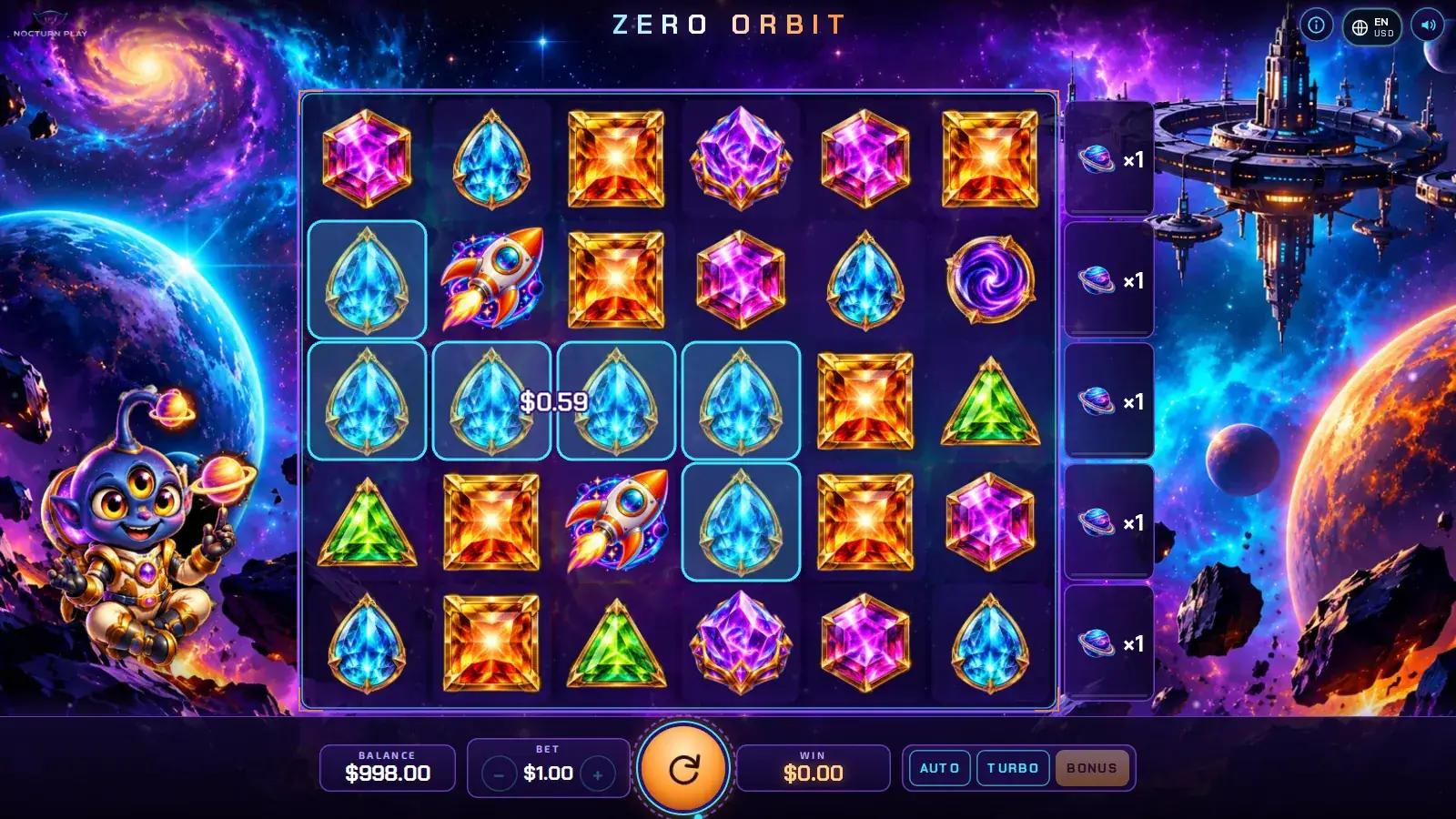
Comets add another push. A comet that drops onto the grid lifts the planet on its row by one step immediately, then also acts as a wild for any cluster except portals. A comet landing at the right moment can turn a ×2 planet into ×3 just before a cluster on that row pays.
Free spins, step by step
- Trigger. Four portals give 10 free spins, five give 12, six or more give 15. The portals also pay a prize on the triggering spin.
- Planets stay put. From the first free spin, planets are no longer reset between spins. Every level gained stays until the bonus ends.
- Retriggers. Three portals during the bonus add 5 spins, four or more add 8. The feature can last up to 40 spins.
- Payout. The total is shown as you head back to orbit and added to your balance.
A typical strong bonus starts quietly, with a few small clusters lifting one or two planets. Halfway through, several rows may be sitting at high levels, and every new cluster that touches them pays a multiple. The "Best planet" counter on screen shows how far the strongest row has climbed.
Buying the bonus
The Bonus button offers 10 free spins straight away for 35× your bet. It is the same feature as a natural trigger with four portals, without the portal prize. It suits players who came for the planets and do not want to wait for them. Because the price is a large share of a session, it is worth deciding beforehand how many buys your budget allows.

Settings and mobile play
Autoplay lets you run a series of spins and can stop automatically when the bonus starts. Turbo shortens the cascade animations. On a phone held upright, the planets sit next to the grid exactly as on desktop, so you never lose track of the multipliers. The language button at the top of the screen switches the game into dozens of languages.
Who should play Zero Orbit
If you like cluster slots but find most multiplier systems hard to follow, the row planets are refreshingly clear: one glance at the right-hand column tells you exactly what the next cluster on each row is worth. Players who enjoy building towards something within a single spin will get the most from it. For a different kind of build-up, the rune rows of the Viking Raid slot fill one by one during its Hold & Win, and Black Vigil stacks wild multipliers on classic lines. Zero Orbit is on its game page, and the other cascade titles are in the cluster and cascade slots section.
Frequently asked questions
Do the planets reset in Zero Orbit?
In the base game, yes: all planets fall back to ×1 at the start of each paid spin. During free spins they keep their level until the bonus is over.
Which planet multiplies a cluster that covers several rows?
The highest one among the rows it touches. Afterwards, every planet on those rows climbs one step.
What does the comet do?
It is the wild, replacing any symbol except the portal, and it raises its row's planet by one step as soon as it lands.
How many free spins can I get?
10, 12 or 15 to start, depending on the portals, with retriggers of 5 or 8 spins up to 40 in total.
How much is the bonus buy?
35 times the bet for 10 free spins.