The Peacock Cube review: a jewel puzzle in a moonlit palace
No reels, no ordinary paylines: a marble cube that twists, jewels that change faces and a bonus night where the board slowly turns to gold. Here is how the 5 October release plays, face by face.
Published 5 October 2026 · Updated 5 October 2026 · Nocturn Play
The Peacock Cube is a jewel game by Nocturn Play, released on 5 October 2026, played on a 3×3×3 cube in 3D rather than on reels. You bet on one, two or three faces, the cube's slices twist like a puzzle cube, and three matching jewels in a line on a played face win; three peacock feathers open the Peacock Night, where winning squares turn to gold. Three gold faces at once pay the game's maximum win, and anyone can try it at no cost on nocturnplay.com, no account required.
Moonlight, marble and two storytellers
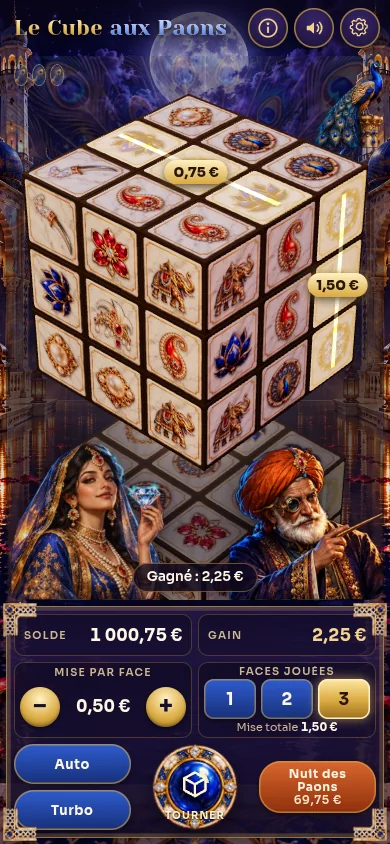
The loading screen says it plainly: "The palace is waking". What wakes is a Mughal palace at night, all white marble threaded with gold, domes and minarets under a full moon and a long pool so still it doubles the whole building. A blue-and-gold peacock has settled on a column to the right of the cube, like a sentry who has seen it all before.
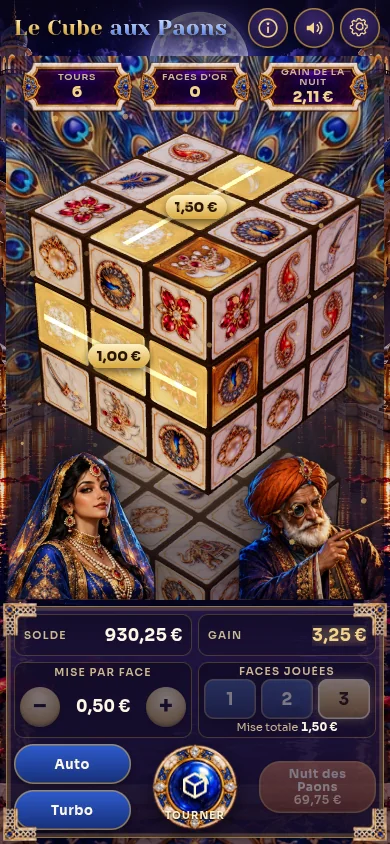
The two characters give the game its warmth. On one side stands a young princess in a deep-blue sari, ropes of pearls at her neck; when a win lands she lifts a diamond towards you. On the other, an old jeweller in an orange turban, white beard, monocle firmly in place, aims his jeweller's stick at the stones as if he were valuing your spin. Youth celebrating, craft appraising: it works like a little fable.
Getting started: two choices and a button
The controls fit on one panel. First, your bet per face. Second, how many faces you play: 1 is the front face, 2 adds the right face, 3 brings in the top as well. The total bet is shown right underneath, so you always know what the next spin costs. Third, the big round "Spin" button.
Press it and the cube makes a full turn, then a few slices rotate a quarter-turn, exactly as on a puzzle cube. Jewels slide from one face onto another as they go. Only the final position matters: each played face is then read line by line.
What pays, and what doesn't
Nine squares per face give eight possible lines: three across, three down and two diagonals. Three identical jewels along any of them and that line pays. Lines on the same face add up, and so do lines on different faces. The white jewel is wild and completes any line.
The elephant tops the table, followed by the aigrette, the jewelled plume once pinned to a turban, then the dagger and the golden peacock. Ruby, lapis lazuli, pearl and carnelian make up the lower end. The showpiece of the base game is the "Full face": all nine squares of a played face showing one stone, which pays a big win for the face as a whole.
One thing to remember: peacock feathers ignore your choice of faces. They count on all three visible faces even when you are only betting on the front.
A sample round, start to finish
Say you bet £0.50 per face on all three faces, £1.50 a spin. The cube turns and two slices twist. On top, three lapis lazuli fall into a diagonal: first winning line. On the right face, a white jewel drops in to finish a column of two rubies: second line. The two amounts add up, the "Won" banner lights and the princess raises her diamond. Better still, two peacock feathers are showing, one on the front and one on top. Next spin, a third lands on the right face. The music shifts and the Peacock Night opens with 8 spins.
On the second spin of the night, a row of rubies wins on the front, and all three of its squares turn gold. Two spins later a slice rotates and carries one of those gold squares across to the right face, where it ends up inside a fresh winning line of daggers. That line contains one gold square, so its win is multiplied by 2.
Inside the Peacock Night
The bonus always plays all three faces, with your total bet shared between them. Three feathers give 8 spins, four give 10, five give 12. Land three more during the night and you get 5 extra spins, with 30 spins as the ceiling. Counters above the cube keep track of the spins left, the gold faces and the night's running win.
The gold rule is the heart of it. Any square that takes part in a winning line turns gold and stays gold until the night is over; when slices turn, the gold travels with them. In a winning line, one gold square doubles the line, two make it ×3 and three make it ×4. As the night goes on the cube gets steadily more golden, and more of each new line tends to be gilded. A face that ends up gold all over pays a treasure and then goes back to marble. The dream is three faces gold simultaneously: the cube turns to solid gold and pays the maximum win of the game, the only cap there is.
Which players it suits, and pacing a session
The Peacock Cube is for players who enjoy watching a board rearrange itself and like following a single stone with their eyes. The number of faces sets the tempo. On one face, each spin is cheap but most possible lines sit idle, so the session stretches out and you are really waiting on feathers, which count everywhere anyway. On three faces, a spin costs three bets per face and every turn gives you far more lines to read. Whatever you pick, keeping the same faces and the same stake for a whole session makes it easier to judge how it is going.
Most of the excitement lives in the night, where gold builds up. If you would rather go straight there, the orange "Peacock Night" button buys it with 8 spins at the price shown for your bet. Autoplay can stop by itself when the night begins, and turbo trims the cube's turns once you know the board well.
How it compares
The obvious cousin is the match-3 puzzle, where you hunt for three identical gems. The difference is that you move nothing here: the slices reshuffle the stones, and wins are read on fixed lines on each face. The other cousin is the famous puzzle cube itself, whose twisting the game borrows without asking you to solve anything. Classic jewel slots line up their gems on flat reels; The Peacock Cube stacks them in three dimensions and lets gold wander from face to face. For another reel-free board from the same afternoon, read our review of The Spindle of the Fates, or, for cannons instead of jewels, the Ghost Fleet review.
On your phone, and where to play
Held upright, the phone version puts the cube at the top, the princess and the jeweller beneath it and every control within thumb's reach. Rotate it to landscape, or load it on a bigger screen, and the paytable moves to the left with the bet panel on the right.
To play for free, open The Peacock Cube's game page and press "Play": no sign-up, no download, a choice of 32 languages, 52 currencies and 11 cryptocurrencies. You will find it under New releases in the catalogue, and under Slots too, even though nothing on it is a reel.
For casinos, the cube comes through SoftAggregator. It is already switched on for every account and joins the lobby beside the rest of the Nocturn Play range: one API, one seamless wallet, 8% of GGR and no setup fee.
Frequently asked questions
Is The Peacock Cube a slot machine?
It is filed under Slots, but it has no reels at all: the board is a three-dimensional cube of jewels, and its slices rotate every time you spin.
How many lines does each face have?
Eight: three rows, three columns and two diagonals. Only the faces you play pay their lines, and wins from several lines are added together.
Do gold squares stay after the Peacock Night?
No. Gold only sets in during the night. A face that turns fully gold pays a treasure and returns to marble, and when the bonus ends the cube looks as it did before.
Can I buy the Peacock Night?
Yes, with the orange "Peacock Night" button, which starts 8 spins straight away. The game shows the price for your bet before you confirm.
Can I play The Peacock Cube without paying?
Yes, on nocturnplay.com. The game page has a "Play" button that opens it in your browser with no account needed.
Category: New, Slots
SoftAggregator: SoftAggregator, casino game aggregator