
Starboard Dice strategy: where to put the line
A dice game with one rule and a hundred settings. This guide explains how the line, the side and the multiplier fit together, and how to build a session around them.
Published 12 October 2026 · Updated 13 October 2026 · Nocturn Play
Starboard Dice is a roll over / roll under dice game from the Nocturn Originals collection by Nocturn Play. A golden die lands on a number from 0.00 to 100.00, you choose a line and a side beforehand, and a win pays your bet times a multiplier that grows as your winning side shrinks, past 40× at the narrowest setting. Admiral Mojo, a monkey in a naval bicorne, does the throwing. Free play is available on nocturnplay.com, no deposit involved.
The one rule
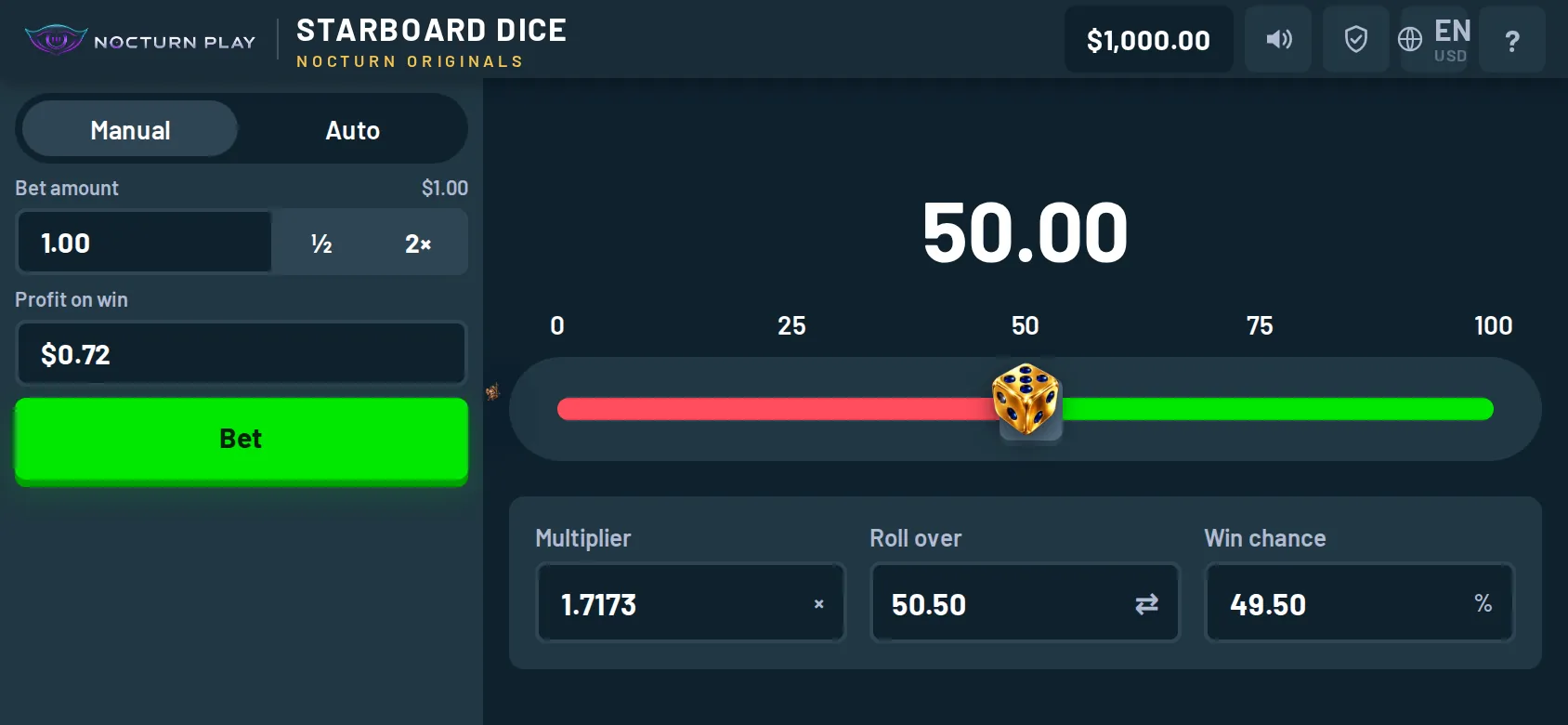
Everything in Starboard Dice comes from a single choice: which stretch of the rail counts as a win. Place the line at 50.50 and pick Roll over, and any result above 50.50 wins. Flip to Roll under and the stretch below the line wins instead. The rail is colour-coded, green for your side and red for the rest, so you always see the deal you are taking before you press Bet.
The game shows three linked numbers: the multiplier, the line, and the win chance. Change one and the other two follow. That makes it easy to start from whatever matters to you. Want a 2× payout? Type 2 in the multiplier box and the line settles where it needs to be. Want the die to have a big green target? Drag the handle until the green covers most of the rail and read off what that pays.
Three ways to set the line
Wide side, small multiplier. Lines that leave most of the rail green pay a fraction above your stake. Wins come often, each one small. This setting suits long, calm sessions and players who like to watch the balance move slowly.
Middle of the rail. Around 50 on either side, the payout sits a little under double the bet. Each roll feels like a coin flip with a little theatre. It is the default when you open the game and the easiest place to learn.
Narrow side, big multiplier. Pull the line towards an end and the green strip gets thin, down to 2 points of the rail. Losses come in runs, but one landing can pay more than forty times the bet. This is the setting for players who come for the one big moment.
None of these is better in the long run. Every setting runs on the same rules; what changes is the shape of the ride.
A short session, roll by roll
You start with a 1 dollar bet, Roll over, line at 50.50. Mojo shakes the die and pitches it down the rail: it stops on 63.18, green, and you take back a little under 2 dollars. Second roll, 22.40, red. Third, 71.05, green again, and the sail on Mojo's mast climbs one notch for the streak.
Feeling bolder, you drag the handle to 90.00. The green strip is now a sliver at the right end and the multiplier jumps to roughly 9×. You halve the bet to 50 cents with one tap. Two rolls land in the red. The third skids along the rail and stops on 94.62, and the profit box you checked earlier is exactly what you collect.
Using autobet without losing the plot
The Auto tab turns those choices into a routine. You set:
- Number of bets. A fixed series, or 0 to keep going until you press stop.
- On win and On loss. Either go back to the base bet, or raise the bet by a percentage you choose.
- Stop on profit and Stop on loss. Limits that end the series by themselves.
A sensible first setup is modest: a base bet you are comfortable losing many times over, reset on both win and loss, and both stop limits filled in. Systems that raise the bet after every loss can look clever over ten rolls and painful over fifty, because the stake grows quickly during a red run. If you try one, the stop on loss is not optional.
What the admiral adds
Most dice games are a slider and a number. Starboard Dice keeps that clarity but gives the throw some weight: the die is a real object that tumbles and settles on the result, Mojo reacts to wins and losses, and the sail tracks your current streak. It doesn't change any outcome, but it turns a list of numbers into something you watch. The sound follows the same idea, with a rattle before the throw and a bright note when green comes up.
Fair by design
The roll is drawn on the server, with a cryptographic generator, at the moment the bet is placed. Your screen only replays it. The Fairness panel gives you the ID of the latest round, so any result can be checked with support.
Who will like it
Starboard Dice is for players who want full control over risk with no reels, no symbols and no waiting. Crypto-casino regulars will feel at home with the layout, and newcomers can learn it in one roll. Rounds take a couple of seconds, which makes it a natural phone game, upright or sideways.
Play now
Head to the Starboard Dice game page for free play in the browser, with no account. For more quick Originals, such as the mines grid of Velvet Vault, browse the games catalogue.
Frequently asked questions
What is the best line in Starboard Dice?
There is no best line. Wide winning sides give frequent small wins, narrow ones give rare big wins; pick the rhythm you enjoy.
Can I type a multiplier instead of moving the line?
Yes. Type a multiplier or a win chance and the line moves to match.
What do Roll over and Roll under mean?
Roll over wins when the die lands above your line, Roll under when it lands below.
Does the sail on the mast change my chances?
No. It only shows your current winning streak; every roll is independent.
Where can I play Starboard Dice for free?
On nocturnplay.com, in any browser, without signing up.